

What Does This Budget Actually Pay For? Funding a Service Level, Not a Number

Association Management Team • 1 October 2026

Share this article

A community budget does more than pay bills. It funds a level of service. Before approving the numbers, boards should understand exactly what those numbers are buying.


Cut the landscaping line by 15%, and nothing happens the next morning.


The grass still gets cut. The irrigation still runs. The pool still gets serviced.


But six months later, the beds may look thin, mulch may be overdue, and owners may start asking why the property does not look the way it used to.


By then, few people will connect those changes back to a budget decision made months earlier.


That is the gap Doug Jenkins' third budget question is designed to address:


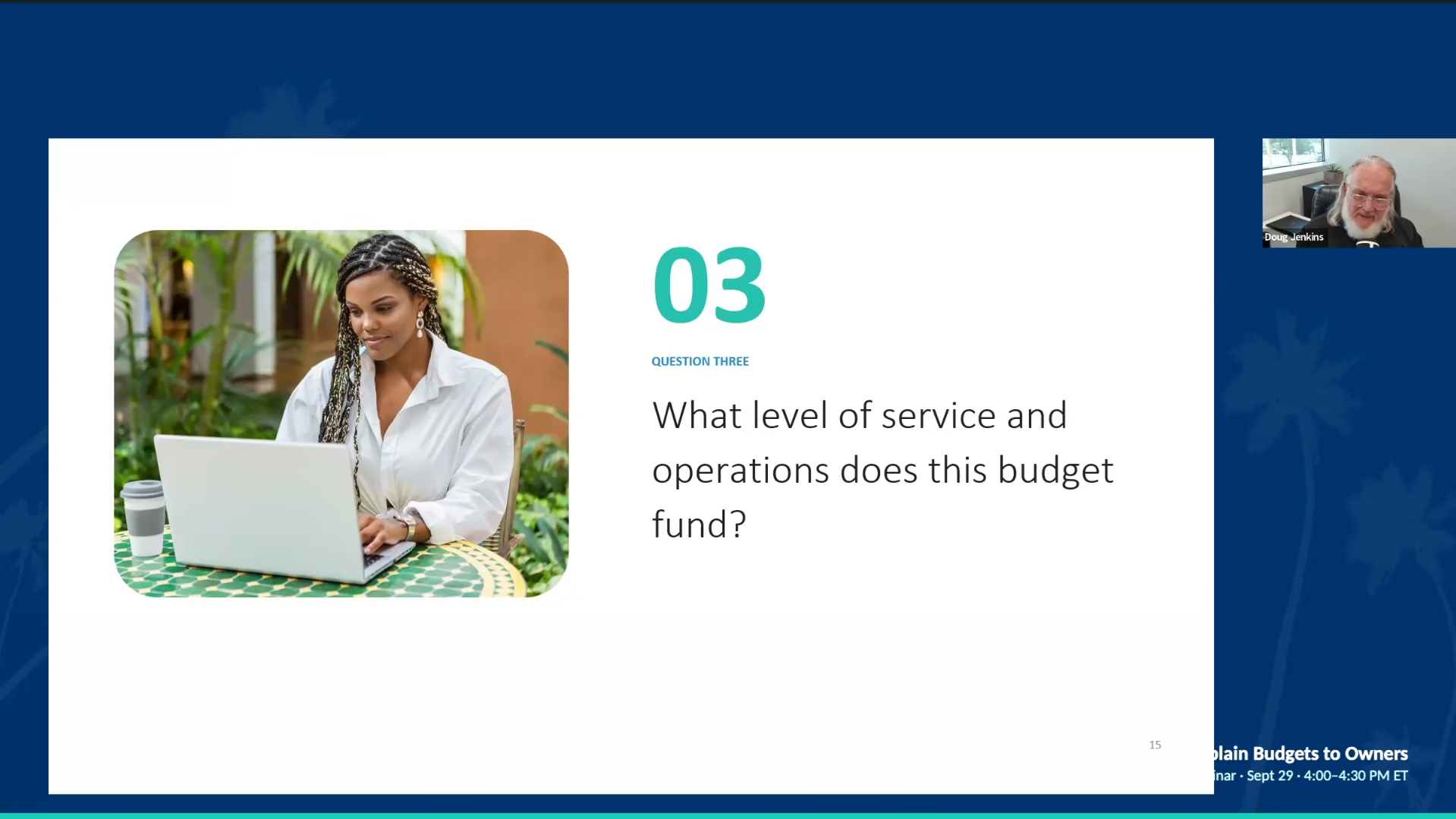
What level of service and operations does this budget fund?


It is a simple question, but it changes how a board looks at its budget.


Instead of asking only whether a number is too high or too low, the board asks what that number actually provides for the community.

A Budget Funds More Than Expenses

Every operating expense represents more than a dollar amount.


It represents an activity, a frequency, a response time, a maintenance schedule, or a standard of service.


Consider a few examples:


  • How frequently are common areas cleaned?
  • How often is landscaping maintained?
  • How quickly should maintenance requests receive a response?
  • How frequently is pool equipment inspected?
  • When is preventive maintenance performed?
  • How often are building systems serviced?
  • Which maintenance tasks are performed routinely instead of waiting for a failure?


Those decisions are often buried inside budget line items.


The board may approve a maintenance budget without explicitly discussing whether the association is funding quarterly inspections, semiannual inspections, or maintenance only when something goes wrong.


The service level can change without the board ever saying, "We are reducing the service level."


That is why the dollar amount alone does not tell the whole story.

Before You Cut a Line, Ask What Stops

One of the most useful questions a board can ask during a budget discussion is:


If we reduce this expense, what specifically changes?


Not just, "Will we save money?"


Ask what the association will no longer receive.


Suppose a preventive maintenance line is reduced by $8,000.


The next question should be:


What does the $8,000 reduction remove?


  • Does a maintenance visit come off the calendar?


  • Does equipment get inspected less frequently?


  • Does a preventive repair get postponed?


  • Does a vendor reduce the scope of its contract?


  • Does the association accept a longer response time?


Or does nothing actually change?


That last answer can be just as valuable.


If a proposed reduction does not change the service being provided, the board may have identified an expense that deserves a closer look.


The important thing is to understand the tradeoff before approving the change.

Translate the Budget Into Service Levels

A good budget conversation moves between two languages.


The first is the language of dollars:


"This line is increasing by $10,000."


The second is the language of operations:


"This increase allows us to maintain the current service frequency and preventive maintenance schedule."


Both matter.


The financial number tells the board what the decision costs.


The service-level discussion tells the board what the community receives in return.


That translation can make budget discussions much easier for directors and owners to understand.


Instead of discussing an expense as an isolated number, the board can ask whether the service being funded is necessary, appropriate, and consistent with the community's needs.

The Lowest Budget Is Not Always the Goal

It can be tempting to view a lower budget as automatically better.


But a lower number may come with a lower level of service, deferred maintenance, or increased operational risk.


That does not mean every expense should be approved simply because it supports a service.


It means the board should understand the consequence of changing it.


For example, reducing preventive maintenance may produce immediate savings.


But if that reduction leads to more failures, emergency repairs, or shortened equipment life, the association may eventually spend more than it saved.


The right question is not simply:


"Can we make this line smaller?"


It is:


"What are we giving up if we make this line smaller?"


That distinction is particularly important for smaller communities, where there may be less flexibility in the operating budget and fewer resources available to absorb unexpected costs.


Smaller Communities Can Feel Service Changes Quickly

In a smaller community, there may be less room for operational delays or deferred maintenance to go unnoticed.


A missed maintenance task can become a larger repair.


A delayed landscaping service can become a visible property issue.


A reduced inspection schedule can mean that a developing problem is discovered later than it otherwise would have been.


The timing and financial consequences will vary by property, system, and service.


But the underlying principle remains the same:


A budget decision can create an operational consequence even when that consequence does not appear immediately on the financial statement.


That is why boards should understand the service level attached to significant expenses before deciding whether to reduce them.

Put the Service-Level Decision in the Record

When a board intentionally chooses a different level of service, document that decision.


For example:


The board reduced preventive maintenance funding by $8,000, moving HVAC servicing from quarterly to semiannual service. The board discussed and accepted the potential increased risk of equipment failure associated with the reduced service frequency.


That is much more useful than simply recording:


"Preventive maintenance reduced by $8,000."


The first statement explains the decision.


It identifies the operational change.


It records that the board discussed the potential consequence.


And it gives future directors important context when they review the budget.


Documentation does not eliminate risk.


It does, however, create a clearer record of how the board arrived at its decision..

Ask These Questions Before Approving a Major Reduction

Before reducing a significant operating expense, ask:


  1. What service does this expense currently fund?
  2. What changes if the expense is reduced?
  3. How frequently will the service be performed under the new budget?
  4. What preventive maintenance or operational activity could be deferred?
  5. What risks could the association be accepting?
  6. Could the change create a larger expense later?
  7. Have those tradeoffs been clearly explained to the board?


These questions do not automatically tell the board whether an expense should increase or decrease.


They give the board the information it needs to make that decision intentionally.

The Budget Should Match the Community's Expectations

Every community has different needs.


A condominium with aging building systems may have very different maintenance requirements from a newer community.


A property with extensive landscaping may require a different service level from one with limited common-area grounds.


A community with significant amenities may have different operational requirements from one with fewer facilities.


There is no universal number that represents the "right" amount to spend on every category.


The important question is whether the budget reflects the level of service the board expects the community to receive.


If the board wants a particular standard, the budget needs to fund it.


If the board wants to reduce spending, it should understand what service or operational change accompanies that reduction.

Make the Decision Before You Make the Cut

A budget workshop should not be limited to reviewing whether expenses went up or down.


It should also give the board an opportunity to connect financial decisions to operational expectations.


Before voting on a significant change, ask:


What level of service and operations does this budget fund?


Then ask what changes if that level is increased or reduced.


That conversation turns a budget from a spreadsheet into an operating plan. It is also a plan someone has to inherit, which is why it matters who is willing to stand for the board.


The board is no longer simply approving numbers.


It is deciding what the community will receive, how frequently services will be performed, and which operational risks it is willing to accept.

Watch the Full Webinar With Doug Jenkins

Doug Jenkins of Association Training Hub covers this question as part of a broader discussion about how Florida condominium and HOA boards can approach budget decisions and explain those decisions to owners.


The full session covers five questions designed to help boards look beyond the arithmetic and understand the reasoning behind the numbers.

Question #3 is a useful one to bring into your next budget workshop:


What level of service and operations does this budget fund?


Because before deciding whether a number is too high or too low, the board should know exactly what that number is buying.

Need Help Understanding What Your Budget Funds?

Your budget should reflect the operational needs of your community, not simply a target number.


Moore Property Management works with boards to help them understand the financial and operational decisions involved in managing their communities.


If your board wants a clearer picture of what its current budget is funding, where service levels could change, and what tradeoffs come with those changes, reach out to Moore Property Management before your next budget vote.

Recent Posts

by Association Management Team • 2 October 2026
Building a candidate pool before the notice goes out

by Association Management Team • 1 October 2026
What a budget buys, beyond the total at the bottom

Person points to a colorful expense checklist on a clipboard beside a calculator on a desk
by Association Management Team • 22 September 2026
For condominium associations that can complete their SIRS alongside a milestone inspection due by December 2026, the deadline is more than a date. Boards should confirm that the required work is complete, documentation is in place, reporting has been handled, and the association is prepared for what comes next.

Hands sketching a blueprint with pencils on a desk, focused on design work
by Association Management Team • 22 September 2026
The SIRS gives a condominium board a roadmap for future repairs, replacements, and reserve needs. The next challenge is putting that information to work. Boards need to prioritize projects, adjust funding, coordinate vendors, and make sure recommendations become part of the community's ongoing maintenance plan.

by Association Management Team • 31 August 2026
Learn the practical principles that guide responsible board decisions, helping you balance homeowner interests, financial stewardship, and long-term community success.

by Association Management Team • 24 August 2026
Follow a structured post-disaster response plan that helps your board organize documentation, communicate with residents, and keep insurance claims moving efficiently.

by Association Management Team • 17 August 2026
Learn what recent legislative changes mean for everyday board operations and the practical governance habits that help communities stay prepared.

by Association Management Team • 10 August 2026
Understand how reserve funding decisions influence purchaser perceptions, financing opportunities, and the long-term financial health of your association.

by Association Management Team • 3 August 2026
Learn how structured vendor evaluation, documentation, and performance management can help boards reduce disputes and make confident contracting decisions.

by Association Management Team • 27 July 2026
Discover practical ways to reduce violations, improve resident cooperation, and help your board enforce community standards with greater consistency and fewer disputes.
Show More